Oil & Gas Chatbot and AI Agent – Transform Your Oil & Gas Operations: Instant Support, Anytime, Anywhere!

AI Agents Transforming Customer Service in the Oil and Gas Industry



Introduction – The Challenge with Traditional Customer Service in Oil and Gas
The oil and gas industry keeps everything moving — from the trucks on the road to the lights in our homes and the factories that build the world around us. It’s a sector built on precision, timing, and trust. But when you look at how most companies in this space handle customer service, it’s clear that part of the operation hasn’t caught up with the rest.
Many oil and gas providers still rely on systems that were designed years ago — call
centres with long hold times, web portals that are clunky and outdated, and apps that most people give
up on after a few tries. Customers spend too much time chasing updates. Distributors wait for someone to
respond. And service reps jump between multiple screens just to find a single piece of information.
This slow, fragmented way of working doesn’t just test people’s patience — it costs money
and trust. In a business where a single delay can throw off an entire delivery chain, inefficiency isn’t
just inconvenient; it’s expensive.
There’s also the human side. Customers today expect quick, personal, and reliable communication — the kind they’re used to getting from modern tech-driven brands. But in oil and gas, those expectations often collide with outdated systems and disconnected tools. Field teams still lack real-time data. Billing issues take days to resolve. And security concerns keep growing as more data moves through digital channels.
 What does downstream mean in oil and gas?
 What is predictive maintenance?
 How is machine learning used in seismic data?
 How does AI improve drilling accuracy?
 How is natural gas extracted?
 What role does AI play in oil and gas?
 Why is pipeline transport
important?
Why is pipeline transport
important?
 What is predictive maintenance?
 What is the future of AI in oil and gas?
 Connect me with a live agent
 Can AI help reduce emissions?
That’s where AI agents are starting to make a real difference. These tools aren’t here to replace people
— they’re here to make everyone’s job easier. An AI agent in the oil and gas industry can answer
questions instantly, pull up the right data, and guide users step-by-step without the wait or confusion.
It’s like having a smart assistant who never gets tired and truly understands how your business works.
Unlike older chatbots that just followed preset scripts, modern AI assistants in the oil and gas
industry can grasp what people mean — no matter how they phrase it.
They keep learning from
every interaction, understand the context of conversations, and deliver accurate answers in just a few
seconds.
Imagine a fuel distributor checking the status of a shipment, a refinery technician
asking for a safety protocol, or a customer wanting to confirm a delivery time — all handled
automatically, accurately, and in real time. That’s what these AI agent solutions for oil and gas are
bringing to the table: service that’s faster, smarter, and built for the way people work today.
In an industry that runs on reliability, these small shifts can create huge ripple effects
— cutting delays, improving communication, and freeing up teams to focus on what really matters: keeping
operations safe, efficient, and moving forward.
The Current World: Manual, Slow, and Fragmented
Let’s look at a typical customer experience in the traditional oil and gas ecosystem.
Scenario
Fuel Distributor Inquiry

Hi, I’m checking the status of my diesel shipment. I placed the order yesterday.”
 Calls the customer service hotline, waits on
hold for 10 minutes.
Calls the customer service hotline, waits on
hold for 10 minutes.

Let me check… can you please share your order number again?
“It’s 4529.
Thanks. I’ll have to contact the logistics team and get back to you by email.
Can’t you check it now?
I don’t have live access to that system. You’ll hear from us in a few hours.

Result:This type of exchange still happens daily across call centers and service desks in the oil and gas sector. The lack of integration between systems, combined with human dependency, often delays simple queries and adds to customer frustration.

Picture this — a customer is waiting to know when their diesel will arrive. Instead of calling customer service, being put on hold, and listening to that same tune repeatedly, they just take out their phone and send a quick message.


Oil & Gas AI Agent
A few seconds later, the reply comes in
Outcome: And that’s it. No phone calls, no waiting, no repeating details again and again. The customer gets what they need instantly — clear, simple, and easy.

It feels different — almost like talking to someone who actually knows you. The tone is friendly, the answers make sense, and everything just flows. This is what modern customer service looks like in oil and gas — fast, personal, and human.
The AI agent isn’t pretending to be a person — it’s just being helpful. It checks the live delivery data, remembers the customer’s routine, and gives honest, useful answers in a way that feels natural. There’s no stiffness, no robotic tone — just a smooth, easy chat that makes life simpler.
No waiting. No confusion. No stress. Just a quick, human-like conversation that gets things done — the kind that makes the customer smile and think, “That was so easy.”
That’s the quiet power of AI in this industry. It’s not about robots taking over. It’s about fixing the little frustrations that used to eat up time — the stuff no one really noticed, but everyone felt. A simple text that saves half an hour. An update that arrives before the question.
This isn’t about making things futuristic. It’s about making them human again — faster, simpler, and finally, a little less painful.
How AI Agents Are Changing Customer Service in Oil and Gas
Artificial intelligence is starting to feel less like a buzzword and more like a helping hand in the oil and gas industry. It’s changing how companies talk to their customers — not just how they run their operations.
Think about it: instead of dealing with long waits or confusing systems, customers can now get quick, clear answers from smart assistants that understand what they’re asking. These AI agents can handle service requests, track deliveries, answer technical questions, and even catch small issues before they turn into big problems.
They don’t just follow scripts — they understand context. They know when someone’s asking about an order, a bill, or a maintenance update, and they respond in a way that feels natural and helpful.
The result? Fewer mistakes, faster service, and customers who actually feel heard.

Can you confirm my gas delivery time?


Yes, your order is on the way and will arrive by 2:10 PM.
Here’s where AI-powered automation is really making a difference — not by replacing people, but by helping teams work smarter and serve customers better.
1. Faster Query Handling and Resolution

Is my fuel order confirmed for today?

Yes, the tanker has been dispatched and is currently en route.
Whether it’s a corporate client inquiring about a fuel delivery or a field engineer seeking equipment documentation, AI agents in oil and gas deliver instant, accurate responses.
By eliminating the need to navigate complex internal systems, AI chatbots cut resolution times from hours to seconds — improving operational efficiency and customer satisfaction.
2. Personalized Customer Interactions
These new AI assistants don’t just respond — they understand. They notice patterns like how often you order, when you need refills, or what services you prefer, and use that to make helpful suggestions.
A refinery might get a quick reminder for maintenance before an issue arises, while a distributor could get a smarter route to save time. It feels natural — like talking to someone who knows your business and wants to make things easier for you.

Will there be any delay in today’s oil delivery?

No, the shipment is running on schedule and will arrive as planned.
3. Security and Fraud Prevention

Can I reschedule my fuel delivery?

Yes, I’ve updated the delivery to your preferred time.
The oil and gas sector handles sensitive data — from supply chain transactions to payment credentials. AI agents for oil and gas companies integrate AI/ML-based verification systems that authenticate users, detect anomalies, and flag potential fraud in real time.
4. 24/7 Intelligent Availability
Unlike human agents, an AI agent in oil and gas never sleeps. It’s available around the clock to
handle customer requests, emergency alerts, or equipment inquiries.
This constant
accessibility is especially valuable in remote oilfields and refinery operations where quick
access to support or documentation can prevent downtime and safety incidents.
This instant support replaces manual lookups and ensures field safety in critical situations.

Pressure alarm showing on valve 5A — what’s the protocol?

Shut off the main feed, release residual pressure, and run the diagnostic sequence. Here’s the step-by-step guide.
5. Multi-Channel, Omnichannel Engagement

How much fuel is being delivered today?

Your order includes 5,000 liters as scheduled.
In oil and gas, nobody sits at a desk all day. People are out in the field, on the road, or
working in control rooms that run around the clock. When something comes up, they don’t want to
dig through an app or wait for an email reply. They just want a straight answer — right there,
right then.
That’s exactly what AI agents make possible. They fit into the way
people communicate. Maybe someone sends a quick message on Messenger, gets a short follow-up
later by text, and then receives the full report by email once everything’s wrapped up.
You can start a chat in one place and pick it up somewhere else without missing a beat. The system is remembered. It knows what you asked before, what was resolved, and what still needs attention.
Whether it’s a vendor asking for equipment status, a truck driver confirming a drop-off, or a customer checking a billing update, the conversation just flows. There’s no sense of dealing with a faceless system — it feels like talking to a reliable person who knows your situation.
6. Scalable, Enterprise-Grade Operations
The oil and gas business doesn’t work on a small scale. It never has. Companies deal with thousands of clients, dozens of regions, and a never-ending stream of requests — all at once.
So, when people hear about AI handling customer interactions, they often ask, “Can it really keep up?” The truth is, that’s where it shines the most. These systems can manage millions of conversations at the same time without losing track. Each one still gets the same accuracy, the same attention to detail.
For global operations, that kind of scale is gold. A customer in Houston, a supplier in Dubai, and a partner in Singapore can all talk to the same system — and it knows who’s who, what’s pending, and where things stand. Everyone’s looking at the same live information, not three different versions of it.

Has my payment been received for the oil order?

Yes, the payment is confirmed and processing is complete.
The real win, though, is consistent. No matter how many people reach out, nobody gets pushed to the
back of the line. No “we’ll get back to you tomorrow.” The experience stays the same — quick,
reliable, and clear.
That’s what AI and machine learning bring to the oil and gas
world: not fancy technology for the sake of it, but a way to make big operations feel smaller, more
personal, more human. It’s not about replacing people. It’s about freeing them — giving the teams
who keep things running the time to focus on what they do best: keeping customers happy and
operations safe.
Multi-Channel Customer Journey in the AI Era
Today’s oil and gas customers expect to engage through their preferred digital channels — not wait on hold or navigate outdated web portals.
A modern AI agent for oil and gas enables fluid customer journeys that span across:
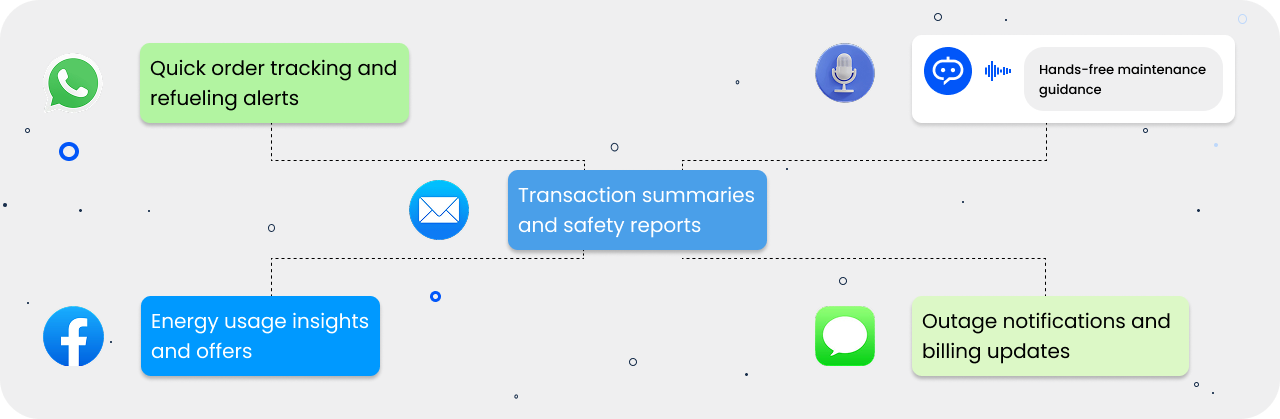
This multi-channel approach makes service experiences socially integrated, consistent, and available anytime, anywhere.
Example:
A refinery supervisor messages via WhatsApp, “Show maintenance history for Unit B12.” The AI agent
instantly replies with logs, technician notes, and predictive maintenance insights — without switching
systems or waiting for manual updates.
Such connected experiences redefine how oil and gas
companies engage customers — turning fragmented support into fluid, conversational journeys.
Key Features of AI Agents for Oil and Gas

Always on
These agents don’t sleep. Whether it’s midnight or Sunday, they’re ready to help — because oil and gas never stop.

They remember you
No need to repeat yourself. The AI keeps track of past chats and picks up right where you left off.

They get personalized
They notice patterns — your regular orders, your schedule — and tailor responses that actually make sense to you.

They keep data safe
Security is a big deal here. Everything is encrypted, verified, and handled with care.

They meet you anywhere
WhatsApp, email, text, voice — it all connects. Start in one place, finish in another.

They scale easily
From a few clients to thousands worldwide, they handle it all without slowing down.
In short, these AI agents are the quiet helpers that keep things moving — steady, reliable, and built for the real world of oil and gas.
Top 10 Real-Life Application Cases for Generative Artificial Intelligence Chatbots
Accuracy and synchronization are what the oil and gas industry has always relied on — it might be getting fuel to the tank on time, staying safe at the wellsite, or keeping the customer informed. However, clunky customer service systems haven’t always been able to keep up with that pace.
That’s where AI agents quietly step in — not to replace people, but to handle the routine work that slows everything else down. From live delivery tracking to safety support, here’s how these tools are making a very real difference every day.
1. Intelligent Customer Service-
Customers do not have to wait on the phone to find out where their orders are. With an AI assistant, the customer will be able to view delivery status, place orders, or even change schedules — anywhere, from the comfort of their phone.
A quick conversation like this eliminates several phone calls — easy, personal, and hassle-free.

“Hey, where is my diesel order?

Hello. Your truck left the depot an hour ago and should deliver at your place at 3:40 p.m. I will notify you when it is getting close.
2. Field Safety and Predictive Maintenance

Show the last service history for compressor 12B.

Not serviced for 27 days. Pressure readings seem extremely high — maybe due for a filter change.
Maintenance delays can cost the plant hours or even days’ worth of downtime. Pump and compressor data are now processed with real-time AI agents, pinpointing minuscule problems before they escalate.
That one small alert can prevent breakdowns, protect equipment, and keep workers safe.
3. Real-Time Dispatch and Vehicle Tracking
In oil and gas logistics, timing is everything. AI agents can pull live GPS data to show exactly where a truck is and when it’ll arrive — no more guessing or calling dispatch for updates.
Clear, to-the-minute directions — exactly when you need them.

Can you tell me where my truck is?

Truck DL-93 is 42 km away and will arrive at 2:10 p.m. Would you like real-time tracking?
4. Seamless Billing and Payment

Please bill for September.

All set! it’s now in your inbox. Care to schedule an auto-reminder for next months’s bill?
Processing payment and issuing invoices can become inconvenient if manually processed. Now, with the intervention of AI agents, it is easy for the customer to request past bills, payment, or reminders — instantly and securely.
Lightning-fast responses mean lightning-fast remittances — happy clients.
5. 24/7 Partner and Distributor Support
Distributors and vendors often work odd hours. With AI agents available round the clock, they don’t have to wait for office hours to get updates or reports.
This type of immediate clarity is what sustains healthy partnerships

When is the ETA for my bulk order #893?
It is booked for 9:30 a.m. tomorrow from the terminal at Surat. The routing instructions are already given to your driver.
6. Safety and Compliance Guidance

What do I do if I lose air pressure?

Shut the main stop valve, retreat 10 meters, and notify the control room. The safety checklist is provided below.
While operating on-site, there is not a moment to leaf through handbooks. With AI agents, instant access to standard procedures for operation and safety procedures is at your request.
That’s life-saving information — delivered instantly when it matters the most.
7. End-Use Energy Consumption and Sustainability Observations
Energy efficiency is becoming a growing issue for business and consumers alike. The AI agents help by keeping track, analyzing patterns, and suggesting wiser routes or procedures that waste less fuel.
These small insights build long-term sustainability habits.

Show me last month’s fuel consumption.

You took 12,500 liters. Route optimization decreases up to 8% fuel consumption and emissions.
8. Predictive Customer Support

My last delivery was delayed.

We observed that your previous order took an exceptionally long time. I already gave a discount to your future delivery — do I need to confirm it for you?
AI can recognize when something’s off — a delayed delivery, a repeated complaint — and step in before it escalates. It’s proactive, not reactive.
Attentive, considerate service that creates loyalty with the passage of time.
9. Group Training and On-Demand Expertise
Field techs and field engineers now have an on-the-job assistant with the help of AI. Whether it is a fast refresher course on safety procedures or a mini video instructional, they receive it at the moment that is convenient for them.
It’s like having a digital trainer that never gets tired.

Demonstrate how to calibrate flow meter XZ-90

Here is the 5-step summarization and the short video.
10. Seamless Multi-Channel Communication

“Remind me to refill next week.

Okay! I will remind you with a WhatsApp next Thursday and send an email confirmation when it is booked.
AI agents enable the customer to interact with whatever channel the customer desires — Messenger, WhatsApp, SMS, voice, or email — and the system automatically takes up all the interaction.
The experience feels natural — no repetition, no confusion, just smooth communication across channels.
In brief:
These small moments — a quick update, a safety reminder, a friendly follow-up — are what make a real difference. AI agents help oil and gas companies get those moments right, every single time. They don’t just speed things up — they make customer service feel more human, even when it’s fully digital.
Benefits of AI Agents in Oil and Gas Industry
Organizations that have adopted AI agent solutions for oil and gas report significant measurable outcomes:

60% reduction
in response time to customer queries
40% cost savings
in support operations
Enhanced compliance
with data governance frameworks
Improved field productivity
through instant AI assistance

Can I change the delivery time for my fuel order?
Yes, I’ve updated your schedule and sent the new delivery window to your phone.
Whether deployed as an oil and gas service desk chatbot or a customer-facing virtual assistant, these tools bring intelligence, speed, and personalization to every interaction
Conclusion
The Future is AI-Driven

Oil & Gas AI Agent
The integration of artificial intelligence into oil and gas is not a distant vision — it’s happening now. From upstream exploration to downstream retail, AI agents are becoming the digital backbone of intelligent customer service.
They deliver:
 24/7 availability
 Data-driven personalization
 Enhanced security
 Reduced operational costs
 Improved satisfaction for both industrial and retail customers
For oil and gas companies seeking to modernize customer engagement, the message is clear — the future belongs to those who automate intelligently.
Explore BotBazaar: The Marketplace for AI Excellence

As more energy enterprises embrace digital transformation, BotBazaar serves as a trusted marketplace to discover, compare, and implement leading AI agent solutions for oil and gas.
It curates enterprise-grade AI solutions that are:

Industry-tested and secure

Compliant with energy and data regulations

Scalable for global operations

Customizable for specific oilfield, refinery, and customer support needs
Here companies can easily identify the best AI agent in the oil and gas industry that fits
their business goals — whether for operations, field support, or customer engagement.
Your Gateway to Enterprise-Grade AI Chatbot Solutions Discover AI chatbot solutions built on
technologies from world-class AI providers like IBM, Google, Amazon, and Microsoft. Each listed solution on
Bot Bazaar is benchmarked for performance, reliability, and 99% conversational accuracy to ensure your
business delivers exceptional customer experiences across every digital channel.
Explore, compare, and choose from vetted AI chatbot solutions tailored to Oil and Gas industry,
designed to boost efficiency, enhance personalization, and strengthen data security.
Frequently Asked Questions (FAQs)
What is an Oil & Gas AI Agent?

An Oil & Gas AI Agent is an intelligent virtual assistant designed to automate operations, safety monitoring, asset management, field support, and customer service for upstream, midstream, and downstream companies. It uses AI/ML to analyze data, answer queries, and trigger workflows across enterprise systems.
What problems can the AI Agent solve in the oil & gas industry?
The agent can support multiple business units by handling tasks such as:
- Predictive maintenance and equipment health checks
- Real-time alerts for safety or environmental risks
- Production data reporting and analytics
- Field workforce assistance and troubleshooting
- Supply chain and logistics coordination
- Customer support for fuel orders, billing, or service requests
Can the AI Agent integrate with SCADA, ERP, and field systems
Yes. The agent integrates with:
- SCADA systems (for real-time telemetry and alarms)
- ERP systems like SAP/Oracle
- Asset management systems (Maximo, IBM EAM)
- Field mobility platforms
- HSE systems for safety workflows
This enables it to pull and update operational data, run diagnostics, and automate tasks.
How does the AI Agent improve safety and compliance ?
The AI Agent enhances safety by:
- Monitoring real-time sensor data for anomalies
- Notifying teams of equipment failures or leak risks
- Guiding field engineers with step-by-step troubleshooting
- Ensuring compliance with OSHA, environmental, and company protocols
- Automating documentation and audit reporting
What communication channels does the Oil & Gas AI Agent support?
The agent operates across:
- Web portals
- Mobile apps
- WhatsApp & messaging platforms
- Radio/voice-assisted devices for field operators
- Control room dashboards
- Email or ticketing systems
This ensures seamless support for both office and field personnel.
Omnichannel Solutions
Always look for solutions that are omni-channel
Today companies are deploying these AI Agent on the following channels