Health Insurance Chatbot – Transform Your Health Insurance Experience: Instant Support, Anytime, Anywhere!

The Rise of Health Insurance AI Agents: How Generative AI Is Transforming Member Experience and Operations




In the past few years, the health insurance industry has undergone a quiet revolution. As member
expectations evolve and administrative demands intensify, insurers are increasingly turning to health
insurance AI agents — intelligent, conversational systems powered by generative AI from leading
technology providers such as IBM, Google, Microsoft, and Amazon.
These AI-driven systems are reshaping how insurers interact with members, process claims, and deliver
services — not through buzzwords, but through measurable impact. From streamlining claims to enabling
24/7 support in multiple languages, AI agents are redefining the way insurers operate in the digital
age.
 What does my health plan include?
 Is this treatment covered under my policy?
 Am I eligible for cashless hospitalization?
 How do I download my policy PDF?
 Do I have maternity benefits?
 I want to buy health insurance
 How long will claim approval take?
 How do I set up autopay?
 How do I renew my policy?
 Can I upgrade my health plan?
 Can you check my policy validityrnational usage?
Confronting Core Challenges in Health Insurance Customer Engagement and Operations
Before exploring success stories, it’s worth stepping back to see why the health insurance sector is primed for disruption by AI agents. Many organizations struggle with:

High volumes of low-value queries — Administrative and eligibility questions often swamp call centers, accounting for a large share of inbound requests.
Fragmented systems and data silos — Legacy policy, claims, eligibility, and CRM systems often don’t talk to each other, making unified support difficult.
Rising member expectations — Consumers now expect 24/7 access, conversational support, multilingual interfaces, and seamless self-service.
Cost pressures and margins under strain — Operational overheads in support, claims handling, and compliance are significant cost drains.
Regulatory, privacy and trust concerns — Health and insurance data is tightly regulated, so any AI deployment must maintain strict security, governance, and auditability.


In this environment, health insurance AI agent solutions—embodying health insurance
chatbot and health insurance AI assistant capabilities—offer a path to transform not just customer
experience
but backend operations and cost structure.
Below, we present four anonymized but real-world deployments leveraging generative-AI platforms from
IBM, Amazon/AWS, Google, and Microsoft. Each case shows how insurers used AI agents for health insurance
in
claim support, policy servicing, multilingual engagement, and contact center automation—with
quantifiable
impact.
Case Study 1
Intelligent Voice Assistant for Pre-Service Queries (IBM / Watson)
A prominent U.S. health insurer (serving 13 million+ members) sought to reduce the burden of provider-inquiries and improve response time.
The insurer received over 1 million provider calls per month, with more than 60% being routine pre-service questions (eligibility, benefits).
Their legacy IVR system funneled many calls to outsourced call centers, resulting in high per-call costs and strained member satisfaction.
The organization built a conversational voice agent combining Watson components and deploying watsonx Assistant for Voice on-premises while the orchestration ran in IBM Cloud.
The agent can interpret provider intent, authenticate access, and respond with eligibility, authorization, and referral data—all via natural voice, without routing to a human.
Voice-based natural interaction (not just text chat)
Hybrid architecture (on-prem/data-sensitive + cloud orchestration)
Deep integration with eligibility and referral systems
Real-time understanding of intent and routing

The assistant now handles ~7,000 voice calls daily across ~120 provider organizations (per business day)
Providers can complete inquiries in ≈2 minutes, without waiting for a live agent
Cost and load relief: many routine calls no longer reach human agents
Beyond cost savings, the program continues to evolve—with growing coverage and richer insights
Ancillary benefit: by monitoring interactions, the insurer reports having gained “a level of insight never had before” into provider behavior and call patterns
Rapid, accurate self-service for providers
Lower outsourcing / call center cost
Reduced average handling times
Better usage analytics and interaction insights
Greater consistency and conversational quality
24/7 voice-enabled policy / eligibility lookup
Pre-service benefit verification
Provider referral/authorization checks
Escalation routing when necessary



Source: IBM case study
Case Study 2
Policy Servicing Chatbot (AWS / Cognizant)
A large U.S. health insurance business undertook a cloud transformation with Cognizant and AWS, building conversational AI services in parallel.


The issuer needed to migrate 146 HIPAA-compliant applications to the cloud with minimal disruption, while modernizing customer-facing services.
Disparate legacy systems and policy servicing workflows made it difficult to deliver unified self-service across channels
The insurer layered a health insurance chatbot onto policy and billing systems, enabling natural-language handling of policy changes, billing, coverage clarifications, and service inquiries.
Behind the scenes, secure APIs and microservices connect the chatbot to billing, policy, eligibility, and claims back ends.
Fully HIPAA- and compliance-aware migration
Reusable blueprint approach accelerates deployment
Tight integration between generative AI layer and back-end systems
Real-time dashboarding and governance built in
Scalability, flexibility, resilience via cloud
Conversational self-service for policyholders
Reduced human support burden
Reduced human support burden
Faster iteration and feature rollout
Self-service portals with conversational overlays
Billing inquiry resolution
Policy amendments and upgrades
Claims status query and document upload
Source – AWS / Cognizant
Case Study 3
AI-Powered Multilingual Engagement & Predictive Underwriting (Google / Upsure)
A prominent Asia-Pacific insurance network (in partnership with an insurtech) adopted Google Cloud and AI to improve underwriting, KYC, and member engagement.
The insurtech platform (serving over 1 million daily users across ~2,000 locations) required 99.9% uptime and strong regulatory compliance.
It needed to automate manual tasks in anti-money laundering (AML), underwriting, document creation, and lead scoring.
The organization deploy AI pipelines for underwriting, AML checks, and conversational services.
Their health insurance AI assistant / underwriting bot performs KYC, runs AML checks during onboarding, scores leads, and generates key documents—all with embedded AI models.
A multilingual support agent allows customers to check policy status, renew, or file claims in multiple languages via chat or voice.
Tight integration between conversational layer and compliance/underwriting engine
Scaling to high concurrency (million+ users)
High availability (99.9% SLA)
Use of Vertex AI / Gemini for model experimentation
The system supports 1 million+ daily users reliably with 99.9% uptime
Through AI-based underwriting and KYC automation, the platform reduces manual burden and accelerates onboarding
By automating AML checks, the platform ensures regulatory compliance without human delays
While the public case does not disclose exact cost savings, the deployment underlines the viability of generative-AI at insurance scale
Faster onboarding, lower friction
Real-time compliance and KYC in conversational workflows
Multilingual support reduces support costs and broadens reach
AI-driven underwriting reduces workload
Conversational onboarding and KYC
Real-time policy and claims support
Proactive member outreach / renewal reminders
Document generation (policy, certificates)


Source:- Google / Upsure
The Role of AI in Driving Sustainability and Growth in Health Insurance
As the health insurance industry undergoes digital transformation, achieving sustainability, scalability, and consistent growth has become a top priority. Health Insurance AI Agents are at the forefront of this evolution, bringing accuracy in automation, decision support, and customer interaction — enabling insurers to operate smarter, faster, and more sustainably.


By automating claims inquiries, policy renewals, and eligibility verification, AI Agents minimize human intervention and reduce administrative costs. This not only accelerates processing time but also lowers the overall carbon footprint by reducing paperwork and in-person visits.
AI Agents can handle thousands of customer conversations simultaneously across web, mobile, WhatsApp, and voice platforms — without the need to expand call center staff. This scalability allows insurers to manage growing policyholder bases effortlessly.
Today’s digital-first customers expect instant, 24/7 responses. AI Agents meet these expectations by delivering personalized, precise, and context-aware answers in real time — setting a new standard for customer satisfaction.
The future of the insurance sector lies in the seamless integration of AI-driven systems. As Health Insurance AI Agents continue to evolve, they will unlock new possibilities for intelligent automation and customer insight.
AI Agents will leverage large volumes of policyholder data to identify potential claim risks, detect fraudulent behavior, and recommend preventive actions with prediction accuracy.
Integration with teleconsultation and digital advisory tools will allow insurers to guide customers remotely — from comparing policies to managing renewals — improving accessibility and reducing reliance on physical offices.
AI will optimize agent schedules, policy renewals, and claim settlement workflows in real time, minimizing idle time and enhancing productivity.
AI Agents will connect with CRM, ERP, and claims management systems, ensuring synchronized data flow across departments and error-free automation.
For insurers, adopting AI-powered Health Insurance Agents is no longer optional — it’s a strategic imperative. Those who embrace this technology today will build future-ready organizations that lead in efficiency, compliance, and customer experience.
For insurers, adopting AI-powered Health Insurance Agents is no longer optional — it’s a strategic imperative. Those who embrace this technology today will build future-ready organizations that lead in efficiency, compliance, and customer experience.
Key Features of the Health Insurance AI Agent Solution

99% Accuracy in Responses and Process Automation
Leveraging advanced natural language models and insurance-specific data, the AI Agent ensures near-perfect accuracy in claim processing, policy assistance, and customer support.

24/7 Omnichannel Support
Engage policyholders across websites, WhatsApp, SMS, mobile apps, and voice assistants — ensuring uninterrupted service across all digital touchpoints.

Automated Claims and Policy Management
Process claims, verify coverage, and manage policy updates automatically with real-time notifications and validation.

Instant Eligibility and Premium Verification
The AI Agent performs real-time policy checks, premium calculations, and eligibility assessments without manual delays.

Multilingual and Multi-Regional Support
Communicate with policyholders in their preferred language, ensuring inclusivity and improved engagement across demographics.

Integration with Core Insurance Systems
Connect seamlessly with CRM, claims processing, underwriting, and policy management systems for synchronized data and workflow automation.

Advanced Analytics Dashboard
Gain actionable insights into claim patterns, fraud detection, customer sentiment, and operational efficiency to drive informed decision-making.

Scalable, Secure, and Compliant Infrastructure
Built on enterprise-grade platforms such as Microsoft Azure, IBM Watson, and Google Cloud, ensuring data integrity, compliance, and easy scalability
Explore BotBazaar Discover Tailored AI Chatbot Solutions
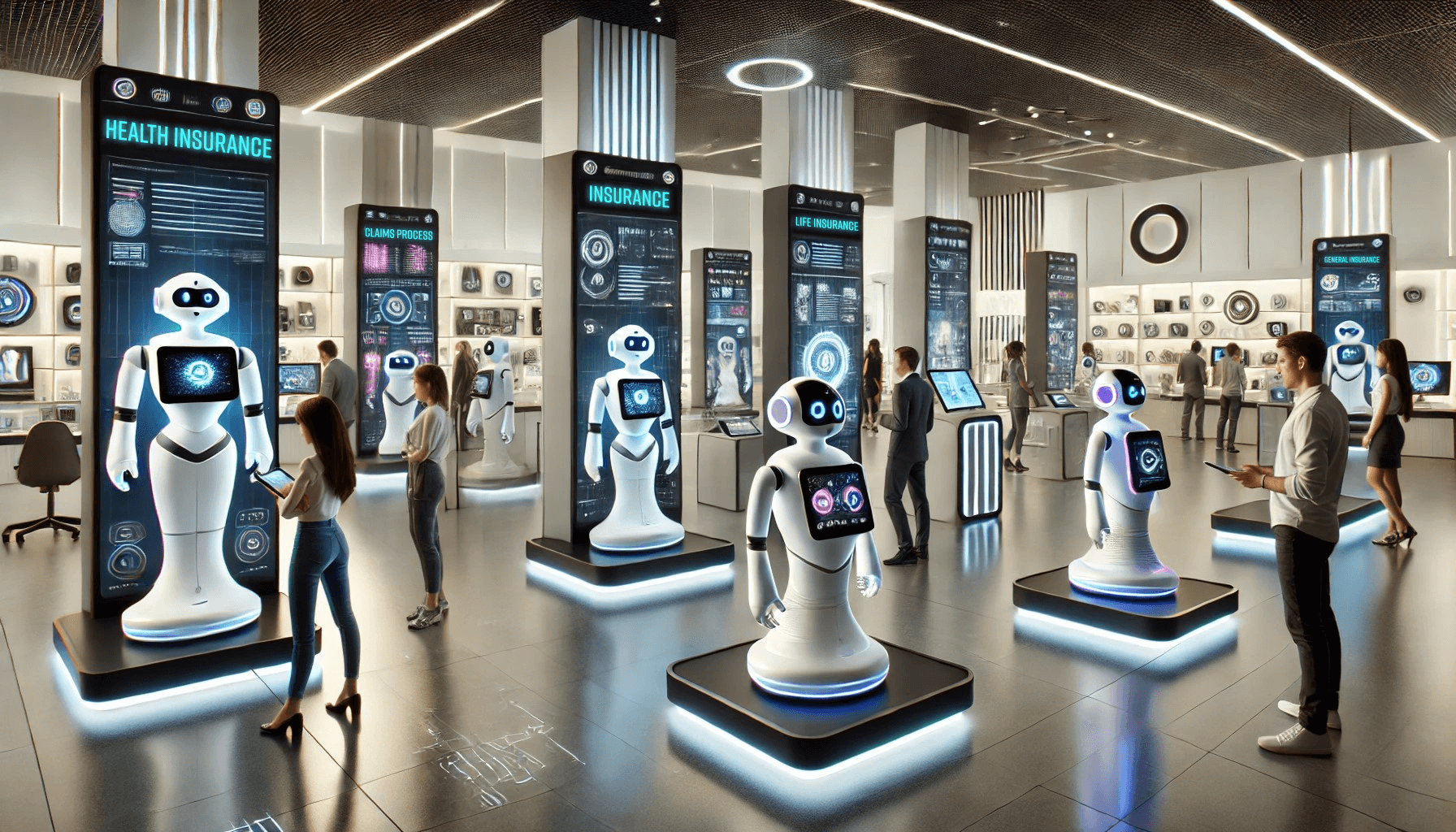
BotBazaar is your one-stop destination for exploring cutting-edge AI-powered health insurance ai agents designed to transform policyholder engagement and operational efficiency. Each chatbot listed on the platform is rigorously vetted for performance, scalability, and security, ensuring you access only the most reliable solutions in the industry.
Why Choose BotBazaar?


Curated Solutions
Listed only the best AI chatbot solutions powered by
industry leaders like Microsoft, Google, IBM, Amazon, and Salesforce.
Diverse Options
From claims processing bots to
advanced multilingual and
CRM-integrated solutions, find a chatbot tailored to your needs.
Comprehensive Evaluations
Each chatbot is evaluated against open standards for
security, ensuring compliance with healthcare and data privacy regulations.
Seamless Integration
You can discover chatbots that integrate with your
existing systems, including CRM platforms, claims management systems, and policy
administration tools.
Take the First Step
Revolutionize your insurance operations with the power of AI. Explore BotBazaar today to compare chatbot solutions, read detailed reviews, and connect directly with providers. Whether you’re a small insurer or a large enterprise, BotBazaar has the right solution to meet your unique requirements.


Frequently Asked Questions (FAQs)
What is a Health Insurance AI Agent?

An AI-powered solution designed for health insurance providers that automates client engagements, policy & claims queries, eligibility checks, and internal workflows—going beyond simple chatbots to deliver intelligent, context-aware responses.
How does it benefit a health insurance company?
It accelerates response times, handles high-volume standard enquiries (e.g., “Does this treatment apply?”, “What’s the status of my claim?”), improves consistency, lowers operational costs, and frees agents to focus on complex cases.
Which capabilities should I look for in such a solution?
Key capabilities include Large Language Model (LLM)-driven natural language understanding, retrieval of policy/claims data, multi-channel support (web, mobile, messaging), human-handoff, analytics dashboards, and compliance with insurance and data-protection regulations.
Can it integrate with our existing systems?
Yes. Most solutions offer connectors or API integrations with policy management systems, claims engines, CRM databases, and knowledge repositories—enabling the agent to pull live data and perform actions rather than just answer FAQs.
Is multilingual and omnichannel support provided?
Many listings support multiple languages (for global/regional markets), and also deliver service across channels such as website chat, mobile app, WhatsApp, and voice/IVR—ensuring insured members get support where they are.
What about compliance, data privacy and risk?
Health insurance is heavily regulated. Good solutions implement encryption, audit logs, role-based access, human-in-the-loop oversight, and adherence to relevant standards (for example HIPAA in the U.S., or local health-insurance regulation in other markets).
What measurable outcomes should we expect?
Metrics to evaluate include reduction in average handling time, increased first-contact resolution, fewer escalations to human agents, higher customer satisfaction scores, cost savings per enquiry, and increased automation of claims or eligibility checks.
How long does implementation take?
Implementation-time varies by scope (number of policies, claims system integration, languages, channels). Some vendors offer “quick-start” packages that can go live in a few weeks; larger-scale roll-outs may take several months.
How do we compare different vendor listings in the marketplace?
When comparing, check: supported insurance processes (claims, underwriting, member services), integration capabilities, deployment model (cloud/ on-premises), supported languages/channels, compliance credentials, vendor’s domain experience in health insurance, analytics capability, and total cost of ownership.
Omnichannel Solutions
Always look for solutions that are omni-channel
Today companies are deploying these AI Agent on the following channels