
AI Agents Transforming Customer Service in the Passenger Transit Industry



🕒 Departure: 18:40
📍 Gate: B12
⏰ Boarding starts at 18:00
I’ll alert you if anything changes 🔔
You’re currently in Seat 18A (Window 🪟)
💺 12C – Aisle – $60
💺 14A – Window 🪟 – $40
💺 22B – Middle – Free
Introduction: Passenger Transit Chatbots
A Generational Shift in Mobility – Why Decision – Makers in Passenger Transit Must Act Now
In today’s rapidly evolving mobility landscape, senior decision-makers in passenger transit—line-of-business heads, CIOs, CTOs—face a stark choice: embrace the transformational power of conversational AI or risk being left behind as the industry shifts beneath their feet. The deployment of passenger transit chatbots, or more broadly, AI agents for passenger transit, is not a mere incremental improvement. It constitutes a generational shift in how passengers access, consume and engage with transit services.
This article is designed to serve you with a detailed, 360° view of how chatbots and AI-powered agents are being used in the passenger-transit sector.


Passenger Transit

📍 Route: 21A
💺 Seats available
Omnichannel Passenger Transit Chatbots: Engaging Travelers Wherever They Are

Passenger communication today extends far beyond ticket counters and customer helplines. Today, the traveller reaches out to transit operators at multiple touchpoints-from websites, messaging apps, and SMS to emails and voice assistants. Serving passengers where they are means having an omnichannel engagement strategy, and in the passenger transit industry, AI agents are making that transformation possible. These intelligent systems ensure that each interaction, from booking to tracking to support, is smooth, efficient, and personalised.
WhatsApp Chatbots for Passenger Transit
Using WhatsApp will allow a passenger transit chatbot to enable various features for its travelers, such as booking tickets, modifying reservations, finding out the schedule of a bus or train, and even live status updates-all from within the chat screen.
Instead of waiting at the counter or fiddling with cumbersome apps, passengers will receive instant responses and real-time notifications on their messaging platform of choice.

What would you like to change? 👇
🕒 Travel date
💺 Seat / class
📍 Boarding station
Your current journey is on 15 Feb.
Available dates nearby 👇
📅 16 Feb – Seats available
📅 17 Feb – Limited seats




Passenger Transit

🚌 Route 21A
💰 Fare: $15
🕒 Travel time: 25 minutes 🚌 Route 18B
💰 Fare: $10
🕒 Travel time: 35 minutes
🚌 Route selected: 21A
📍 Departure: City Center
📍 Destination: Central Station
🕒 Departs in 8 minutes
💺 Seats available

Website Chatbots for Passenger Transit Services
Integrated right into the websites, these AI agents for passenger transit assist in ticketing, fare information, route suggestions, and luggage policies on demand.
Thus, they guide passengers step by step to reduce booking errors and smooth the digital journey.
SMS Chatbots for Low-Connectivity and Remote Areas
In areas where internet connectivity is poor, the chatbots utilize SMS to communicate with passengers for necessary actions like changes in route, delay, and other safety purposes. This way, inclusivity and access become possible, especially for rural commuters and low-connectivity travelers.


Passenger Transit
🕒 New departure: 7:55 PM
📍 Platform: 6
We’ll update you if it changes.
We’ll alert you if rebooking is needed 🔔


Voice-Enabled AI agents in Passenger Transit
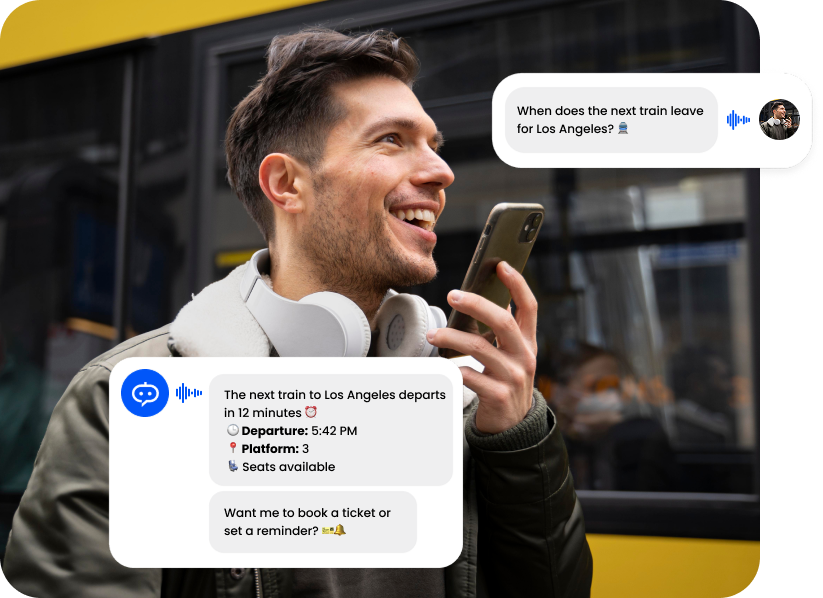
The voice-enabled AI agents are reshaping the world of access for passenger transit. Instead of squinting at a display or fiddling with a keyboard, all a traveler does is ask, such as “When does the next train leave for Los Angeles?” or “Book me a bus to Houston for tomorrow,” and instantly receive a conversational response.
These voice systems are a godsend for elderly passengers and those less comfortable with reading or typing, allowing transit services to reach every demographic.
E-mail Chatbots for Passenger Communication
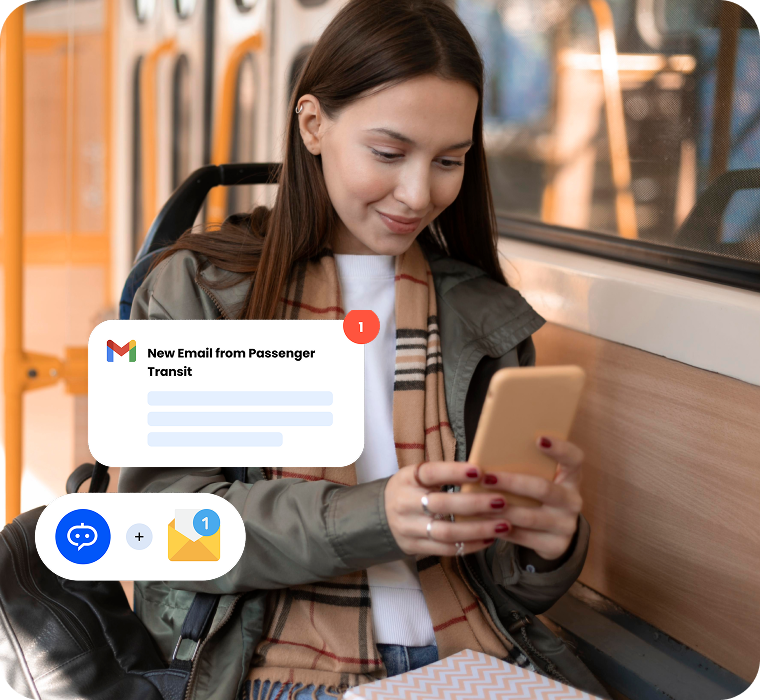
The automated e-mail chatbots in the passenger transit industry handle all the mundane queries about confirmation of tickets, refund tracking, service disruptions, and so on, and free the staff to work on operational efficiencies and critical customer interactions.
Through the delivery of a unified, always-on experience across every communication channel, passenger transit AI agents make transit systems more responsive, inclusive, and user-friendly.
Whether a traveler is more into chat, SMS, voice, or email, AI agents for passenger transit develop consistent, personalized experiences-empowering operators to enhance efficiency, increase ridership, and earn trust across every stage of the passenger journey.
Why the Passenger Transit Industry Needs AI Agents Now

Passenger Transit
Puoi controllare il saldo rimanente?

🎓 Tipo di abbonamento: Abbonamento mensile studente
📅 Valido fino al: 28 febbraio
💳 Saldo rimanente: $49
The prevailing challenge

Passenger transit organizations operate in complex, multi-modal environments (train, bus, taxi/ride-hail, shuttle) with legacy systems, variable passenger behaviours, high volume of service-related inquiries and increasingly diverse user demographics (digital-savvy & non-digital).
Many operators still depend on conventional digital channels (apps, websites) or human call-centres for passenger engagement—leading to slow response times, higher operational cost, poor inclusion of non-digital users (those who can’t read/write or don’t use apps) and missed revenue opportunities.
At the same time, passengers expect real-time information, self-service, multilingual support and accessible voice or chat options — and they’re ready to abandon operators who do not deliver.
Conversational AI agent as a strategic response
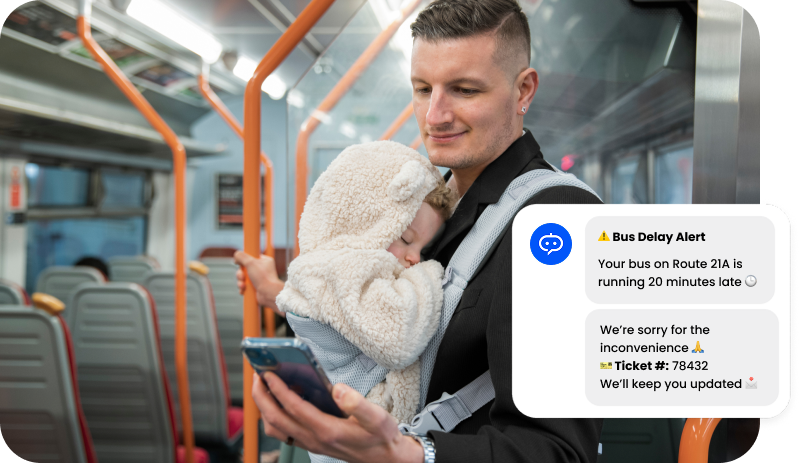
The deployment of a Passenger Transit Chatbot or Passenger Transit AI agent allows transit operators to provide frictionless self-service, real-time passenger interaction across channels: web chat, mobile chat, voice assistants, SMS, and IVR.
Voice-enabled conversational agents open accessibility to passenger segments that do not interact through applications or websites, such as the elderly, visually impaired, low-literacy, or mobile-featurephone-only, hence expanding the accessible market.
Automation of such repetitive inquiries regarding seat/route information, delays, or ticketing will provide clear business reasons that it frees up staff to undertake high-value work, reduces operations costs, and improves response time to queries and passenger satisfaction metrics. Improved ridership retention, new acquisition via inclusive channels, and hence revenues.
The generational shift
This is not incremental. The rise of generative AI and large language model-driven agents means the conversational layer is now context-aware, voice-enabled, and multi-turn dialogues are possible.
The message to decision-makers: if you do not adopt conversational AI in your passenger transit operation, you risk being “the dinosaurs” of transit—out-matched by competitors (or new entrants) who do engage via inclusive conversational channels.
Sub-Categories of Passenger Transit Chatbots
To frame the market and solution-space, let’s break down the major sub-categories of chatbots in the passenger transit industry by mode of transport:

Train service chatbots
They serve rail and metro systems for urban mass transit, suburban commuter rail, or intercity train operators. Use cases include, but are not limited to, live train status, platform/coach position information, reservations, disruptions, and accessibility support.

Bus service chatbots
Covering city buses, inter-city coaches, and shuttle services. Use-cases: timetable look-up, seat booking, live bus tracking, ticketing, cancellation/refund flows, multilingual chat, voice support.

Taxi and ride-hail service chatbots
For on-demand transport-taxi, ride-hailing, and shared mobility use cases include ride booking through chat or voice, estimation of fares, driver-status updates, cancellation and re-booking, support for multiple languages, and a voice interface for non-app users.
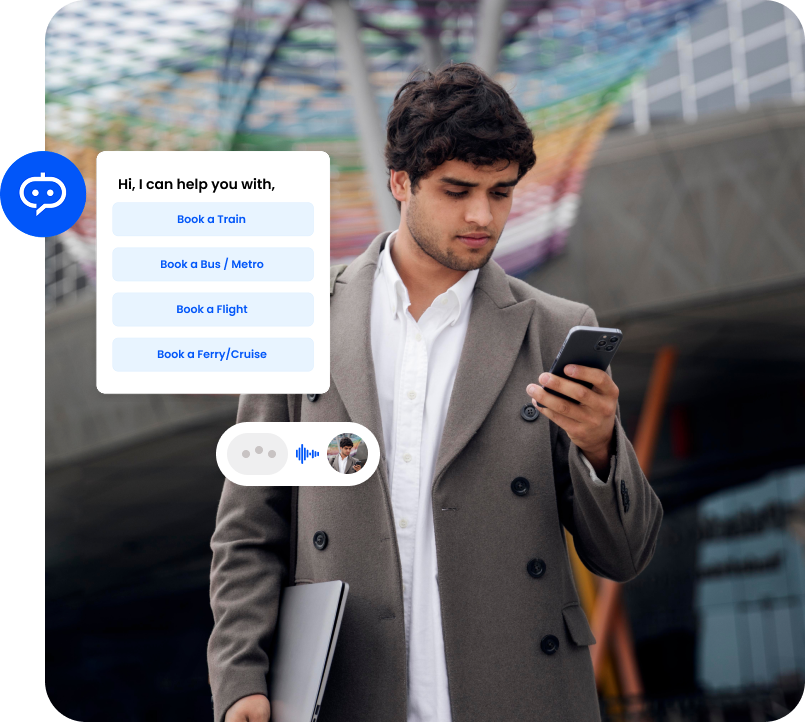
Top 10 Real-World Use Cases of Passenger Transit AI agents
The rise of AI agents in passenger transit has changed the way people move around and use transportation systems. From booking and scheduling to real-time support and predictive safety, passenger transit AI agents around the world are making mobility faster, more inclusive, and data-driven. Here are ten examples of how such technologies can actually impact public and private transportation operations around the world.
Multilingual Incident Reporting Chatbots

In the traditional setup, passengers had to fill out forms or contact helplines, usually hindered by language barriers and delays. Today, AI agents for passenger transit can record incidents instantly in multiple languages; passengers can log issues in real time through messaging apps or websites.
For example, the Chicago Transit Authority introduced multilingual passenger transit chatbots, increasing reporting efficiency by 63% and thus improving rider safety and satisfaction.
Outcome: faster reporting, more confident passengers, and reduced operational costs.

WhatsApp Ticket-booking Chatbots
Previously, passengers needed to install transit apps or visit physical counters to book tickets—excluding non-digital users. In the new approach, regional language ticket booking has been enabled by WhatsApp-based chatbots in the passenger transit industry.
Delhi Transport Corporation chose a WhatsApp AI agent for passenger transit that powered 1.4 million ticket sales.
Outcome: Increased ridership, fuller occupancy, and capturing new segments of customers.
Real-Time Bus Booking and Updates
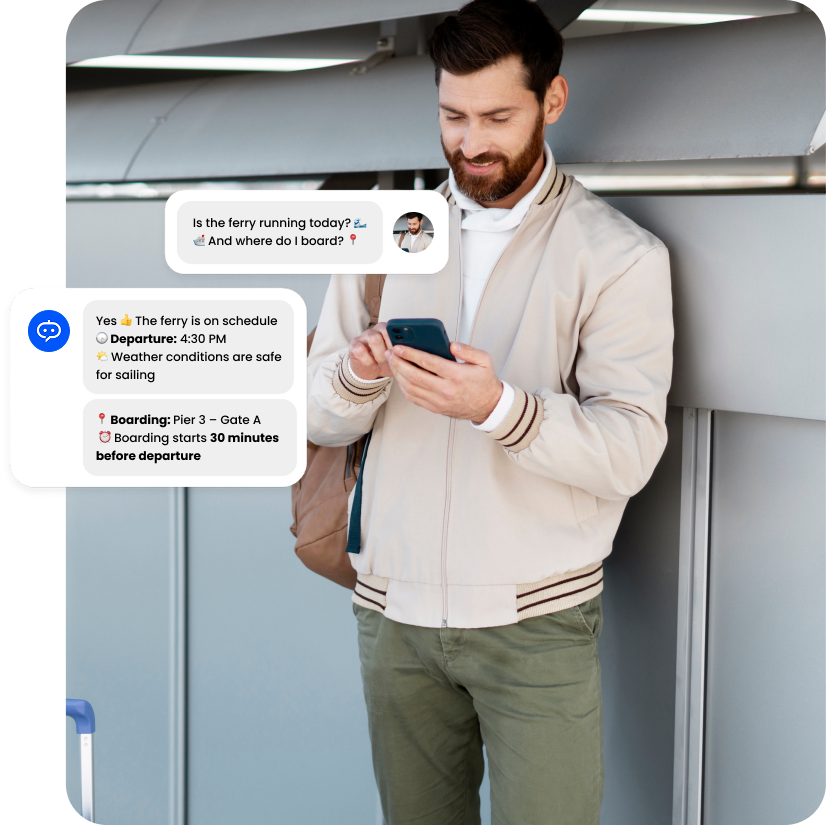
Without AI, the booking systems were confined to the website and apps only, without multilingual and real-time support. Passenger transit AI agents now provide ticketing, live route tracking, and status updates on WhatsApp, Messenger, SMS, and other various channels.
The platforms, such as Rybo.ai, provide commuters with access to seat availability and delays instantly and reduce abandonment while enhancing convenience.
Outcome: Increased conversion rates, higher passenger engagement, and fewer support calls.
Ride-hailing self-service Chatbots
Traditional customer support in ride-hailing involves email and call centres, mostly with very long delays. By deploying their chatbots for passenger transit, companies like Lyft use AI assistants to solve driver and rider queries in real time, thus reducing resolution times by 87%.
AI agents in the passenger transit industry perform tasks such as cancellations, fare disputes, and route suggestions with no human intervention.
Outcome: Reduced support costs, more reliable service, quicker onboarding of drivers.
Taxi Booking and Support Automation
Manual booking and customer handling tend to slow down operations and frustrate users. With the Aegean Taxi passenger transit chatbot, the company automated booking, fare calculation, and customer queries. Wait times fell below a minute, while driver utilisation increased substantially.
Outcome: Faster service, higher trip completion rates, improved customer loyalty.
Multi-Modal Journey Planning Chatbots
In the old system, passengers had to change between different metro, bus, or taxi apps or websites. The new AI agent integrates all passenger transit modes into one interface, enabling travelers to plan, book, and pay for an end-to-end journey within one chat.
Foshan Smart Campus in China implemented such a chatbot in the passenger transit industry by merging bus, metro, and parking services.
Outcome: Unified experience, increased usage of public transport, and new commercial revenue channels.
Train Live-Status and Assistance Chatbots
Before AI, passengers relied on websites or call centres for train status updates that often came with a downside of moving slowly and having poor accessibility. With passenger transit AI agents, passengers now get this information in real-time through natural language interactions, from live train tracking and details on platforms, right down to seat confirmations.
Outcome:Higher satisfaction, reduced inquiry load, and opportunities to upsell premium services.
Data-Driven Decision Support AI agents
Traditionally, analysts would extract operational data into spreadsheets or through SQL queries, which delayed insights. Modern AI agents working in the passenger transit industry can perform database queries and route visualisations, presenting performance dashboards via chat. Transit managers can now ask, “Which route has the highest delay rate?” and receive instant answers.
Impact: Faster, data-backed decisions; better route optimisation; higher resource utilisation.
Outcome:Faster, data-backed decisions; better route optimisation; higher resource utilisation.
Predictive Safety and Tracking Chatbots
Previously, safety updates were reactive, depending on manual monitoring. Now, AI agents for passenger transit combine IoT and machine learning to predict accident-prone zones, alert passengers, and recommend alternate routes in real time.
These passenger transit chatbots notify travelers via WhatsApp or SMS if their route encounters risk.
Outcome:Enhanced safety reputation, reduced liability, improved public confidence.
Ticketing and Customer Service Automation
Over tickets and services, passengers depended either on websites or on the counter; thus, often delays were experienced. In passenger transit, ticketing and support are now fully automated with the integration of chatbots.
Transit Bot integrates ticketing wallets, refund processing, and live route data in one single conversational interface.
Outcome:Reduced service cost, higher self-service adoption, and passenger availability 24/7.
Old World vs. New World Transformation
The traditional “old world” of passenger transit was defined by long queues, single-language systems, and delayed communication. The “new world,” powered by AI agents for passenger transit, enables real-time, multilingual, and multimodal interaction over chat and voice. More importantly, with voice-enabled AI agents, operators can now engage with non-digital users-fellow passengers who cannot read or write-to create inclusivity at scale. This is a generational shift in which conversational AI not only makes access to transportation services more convenient but also democratises it.
Old World

Passenger Transit

New World
Passenger Transit
✈️ You’ll be auto-rebooked on the next available flight.
🍽️ Meal vouchers are available.
💺 Lounge access is included.
🍽️ Meal vouchers sent 📲
💺 Lounge access confirmed
Put differently, any public transit operator embracing the use of passenger transit chatbots is future-proofing their system for accessibility, efficiency, and loyalty within a very competitive ecosystem.
Integrated AI agents can help passenger transit providers turn everyday travel into a connected, intelligent, and accessible experience. Find solutions, compare features, and reach out to providers directly for your organisational needs in improving the operations and engaging your customers in passenger transit with the help of the non-profit marketplace BotBazaar.
Channels, Voice, and Inclusive Customer Segments
When implementing a chatbot in the passenger transit industry, it is essential to consider all the channels and access modes. A narrow channel strategy limits reach: an inclusive implementation expands both service and market.

1
Web chat via operator website

2
In-app mobile chat

3
Social-media chat: WhatsApp, Facebook Messenger and Telegram

4
SMS Chat for low smartphone users

5
Voice-enabled assistants: IVR voice bot, smart-speaker, and mobile voice

6
On-station kiosks or screens with chat/voice interface

7
Multilanguage support, both text and voice
Why do these deliver maximum revenue impact?

Channel expansion
In supporting web, app, social, and voice for chat/voice, the operator reaches beyond the digital-app-only segment. This increases ticket sales from new demographics such as voice users and low-digital users.

Operational cost reduction
Automating the queries frees up staff, reduces waiting times, improves satisfaction; the amount saved is the cost equivalent to incremental revenue.

Self-service friction removal
Ticket booking, live updates, and route planning enablement via chat reduces drop-offs; increased conversion is higher.

Passenger Retention & Trust
Real-time information, multiple language support, and inclusive channels enhance passenger loyalty and lifetime value.

Brand differentiation
Operators are perceived to be more approachable and modern, attracting more ridership and partners.

New markets & pass-segments
Non-app users, voice-users, multi-lingual travelers become reachable — new revenue streams.

Cross-selling & Ancillary Services
for example, suggesting upgrade routes, alerting premium services, and push promotions via chat.
Key Benefits of Passenger Transit AI agent
The introduction of AI agents in the passenger transit industry is giving transit operators around the world transformative gains. Such intelligent systems redefine the service quality, efficiency, and inclusiveness of service at the level of trains, buses, and taxis.

Improved Passenger Satisfaction
Real-time, conversational assistance ensures quicker query resolution and personalized journey support, improving the overall satisfaction and trust of riders by as much as 35%. Equipped with AI agents that respond like humans at 99% accuracy, travelers receive consistent and dependable information at each touchpoint.

Operational Efficiency
Automation powered by passenger transit chatbots reduces human workload by almost 40%. The system automatically performs ticket verification, seat allocation, and route updates, freeing staff to concentrate on high-value operations.

Cost Savings
Automating routine inquiries and offering digital ticketing through chat significantly reduces call centre and administrative costs. Transit agencies can save millions each year by transferring passenger engagement to AI-driven channels.

Accessibility and Inclusivity
Voice-enabled, multilingual chatbots in passenger transit industry empower people of all literacy levels and languages. Passengers can simply speak or text in their preferred language to book tickets or receive travel assistance, bridging divides in both areas for greater inclusion.

Transparency
Every interaction with a Passenger Transit AI agent is traceable and auditable, thereby promoting accountability and data-driven decisions for continuous improvement of service delivery.

Scalability
AI-driven chatbots manage millions of interactions simultaneously with no additional staffing, thus always providing support during peak hours of travel and disruptions.

Security and Compliance
Transit-focused AI agents for passenger transit are installed with encryption, data masking, and access controls to make sure passenger data remains safe, and compliant with regional standards.

Future-Readiness
Their integration with IoT devices, GPS, and digital wallets situates passenger transit chatbots to act as enablers for smart mobility ecosystems in next-generation transportation.
Core Features of Passenger Transit AI agent Solutions
Advanced AI agents within the passenger transit industry have been designed to handle the most complex, real-time transit operations with enterprise-grade capabilities.

Omnichannel Support
Seamless integrations across WhatsApp, Messenger, SMS, email, and voice make sure communication is consistent on all platforms.

24/7 Availability
Always-on passenger transit AI agents provide around-the-clock support for ticketing, inquiries, and live status updates.

Integration with Transit Systems
Integrates directly with ticketing software, fleet management, GPS tracking, and CRM systems.

Multilingual Capabilities
Real-time translation for communicating with all kinds of demographics.

Workflow Automation
Automates critical operations, including form submission, passenger check-in, luggage tracking, and complaint logging.

Data Security & Compliance
Built-in encryption, role-based access, and compliance frameworks ensure that data handling is secure.

Voice-Enabled Interaction
Hands-free interaction lets passengers, seniors and non-digital users speak naturally to book or get route assistance.

Multimodal Capabilities
Supports text, voice, and even image-based inputs-alike QR code scanning for tickets or receipts.

Live Agent Escalation
Complex travel issues are routed smoothly to human agents from chatbots for passenger transit.

AI Analytics
Provides real-time insight into trends in ridership, service quality, and passenger sentiment to drive evidence-based improvements by operators.

99% Accuracy in Passenger Query Handling
Advanced AI agents for passenger transit are trained with large, context-aware datasets and can reach up to 99% accuracy in solving inquiries and giving travel updates to reduce misinformation and frustration among passengers.
Impact: Building Smarter, Safer, and More Connected Transit Systems
Adoption of AI agents in the passenger transit industry is not just about efficiency, but also about how travelers connect with mobility services.
Public transit networks using passenger transit chatbots have achieved:
30%
improvement in satisfaction scores
30% improvement in passenger satisfaction scores as a result of personalized interactions.
40%
reduced manual workloads
Manual workloads are reduced by 40% resulting from automated bookings and support.
50%
faster response
50% faster response times for consultations, cancellations, and rescheduling
These measurable outcomes translate into stronger public trust, optimised operations, and increased ridership retention across both the public and private transport networks.
Future of AI in Passenger Transit
As AI matures, AI agents for passenger transit evolve from reactive systems to predictive, proactive companions. Envision a passenger transit chatbot that would automatically remind one about the next train departure, warn about traffic before your ride, or recommend the cheapest route across multiple transport modes.


♿ I’ve booked wheelchair assistance from check-in all the way to boarding.
📍 Terminal 2, Zone B
These systems can now, with generative AI, explain policies of transit policies, summarise any travel update, or even assist visually and vocally to bridge literacy and accessibility gaps. Future-ready AI agents in the passenger transportation industry will deliver personalised recommendations, dynamic pricing management, and emergency coordination through voice or chat.
Early-adopter transit organisations will be leading the next wave of smart mobility, ensuring their networks remain competitive, inclusive, and adaptive to changing passenger expectations.
Passenger Transit AI agents Implementation Best Practices
To successfully deploy AI-powered passenger transit chatbots, the operators should follow these best practices:
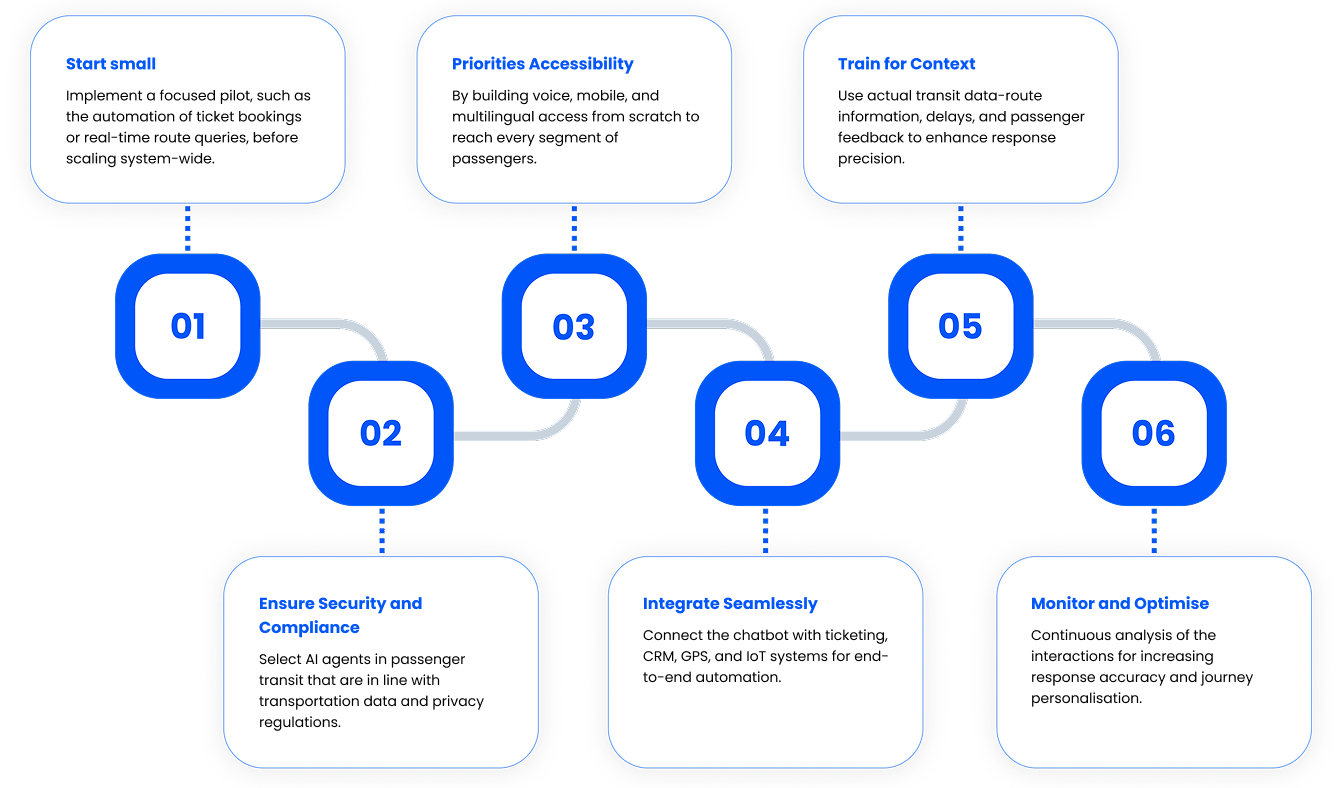
Conclusion: The Generational Shift in Passenger Transit
This moves toward the use of AI agents in the passenger transit industry represents a generational transformation, not just a technological upgrade. Transit operators can combine automation, voice access, and 99% accurate conversational intelligence to deliver universal mobility for both tech-savvy and non-digital passengers.
Those embracing passenger transit AI agents are redefining convenience, safety, and inclusivity in travel—while opening new avenues for revenue and operational efficiency.
Explore BotBazaar, the global marketplace for passenger transit AI agents, offering solutions powered by Microsoft Copilot Studio, Google Cloud, and Amazon AI. Enjoy 99% accuracy, 99% uptime, and seamless integration with POS, CRM, and ERP systems.
Discover trusted and ready-to-deploy solutions at BotBazaar, the non-profit marketplace that connects transit providers with leading chatbots for passenger transit solutions. Compare features, evaluate live demos, and connect directly with vendors offering AI tools driving real-world impact in the passenger transit ecosystem. Choose from trusted providers with proven deployments across transportation industries.
Why Choose BotBazaar

Curated AI Solutions for Passenger Transit Operators

Powered by Global Tech Leaders

99% Accuracy & Uptime

Seamless Integration with Transit Systems
Effortlessly connects with:
Ticketing platforms
Passenger Information Systems (PIS)
CRM/ERP systems
Fleet management dashboards
Verified Vendors & Industry-Specific Options
Secure Compliance with GDPR & Local Transit Regulations

Passenger Transit

🔵 Blue Line → change at Park Street
🔴 Red Line to Central Station
⏱️ 18 minutes total
Take the First Step
Visit BotBazaar to compare passenger transit AI solutions and connect directly with verified providers ready to modernize your mobility operations.
Frequently Asked (FAQs)
What is a Passenger Transit AI Agent?

A smart virtual assistant that automates passenger queries, ticketing help, and real-time travel information.
How is it different from a basic chatbot?
It goes beyond FAQs by integrating with ticketing, PIS, and operations systems to perform end-to-end tasks.
Is it affordable for small transit operators?
Yes, flexible subscription plans make it budget-friendly for small bus and regional transit services.
Can it integrate with my current systems?
Yes, it connects seamlessly with ticketing tools, passenger information systems, and CRMs.
Does it support multiple languages?
Most solutions support 40+ languages for diverse passenger communication.
How accurate is the AI agent?
Leading models deliver 99%+ accuracy in handling passenger queries.
How long does setup take?
On average, the system goes live within 2–4 weeks, depending on integrations.
What ROI can I expect?
Reduced call volume, higher passenger satisfaction, and improved ticket conversions within weeks.
Can it handle peak travel rush and high query loads?
Yes, it’s built for enterprise-scale performance with 99% uptime.
How do I get started through BotBazaar?
Just visit BotBazaar, compare verified providers, and connect directly to begin deployment.
Omnichannel Solutions
Always look for solutions that are omni-channel
Today companies are deploying these AI Agent on the following channels