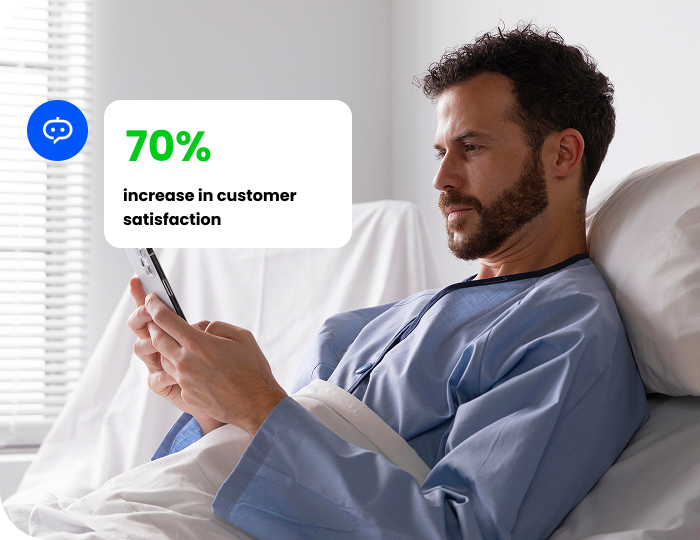
Transforming Hospital and Clinic Patient Support with AI-Powered Chatbots: A Seamless Future
In the fast-paced world of healthcare, where timely assistance can make all the difference, hospitals and clinics are under constant pressure to manage overwhelming patient demands while delivering accurate, prompt, and personalized support. Yet, traditional patient service channels—such as phone lines, web & mobile apps, and in-person administrative staff—often fall short of meeting these demands. Long wait times, limited availability, inconsistent communication, and overburdened staff are just some of the challenges faced by healthcare providers today.
In such a critical environment, AI-powered healthcare chatbots for patient support emerge as a groundbreaking solution. These chatbots, driven by the latest in generative AI technology, offer a paradigm shift in how hospitals and clinics engage with patients. No longer constrained by time zones or staffing limitations, Gen AI powered hospital patient service chatbots provide 24/7 support, real-time responses, and a seamless patient experience across various channels. Whether booking appointments, answering routine inquiries, or managing patient records, these bots are transforming the landscape of patient support.
This article delves into how AI-powered hospital chatbots for patient support are redefining hospital and clinic services, contrasting the inefficiencies of the ‘Current World’ with the cutting-edge solutions of the ‘New World.’ Through detailed scenarios, we’ll explore the practical impact of these bots and how they are elevating patient care, efficiency, and satisfaction.
Let’s explore a series of realistic patient interactions to highlight the stark differences between the traditional support system and the AI-powered chatbot experience.
Scenario 1
John, 58, needs to schedule an appointment with a cardiologist. He calls the hospital but faces a long wait.
All our agents are currently busy. Please stay on the line.
Finally, someone is picking up.
How may I assist you today?
I need to book an appointment with a cardiologist.
Next available is Monday at 10:00 AM. Would you like to confirm?
Yes, please.
Outcome: John’s appointment is booked, but the process is frustrating and time-consuming, requiring him to wait on hold and provide repetitive information.

As John was surfing Facebook, he just uses an AI-powered healthcare chatbot on Facebook for patient service to schedule appointments. He messages the hospital via Facebook Messenger.
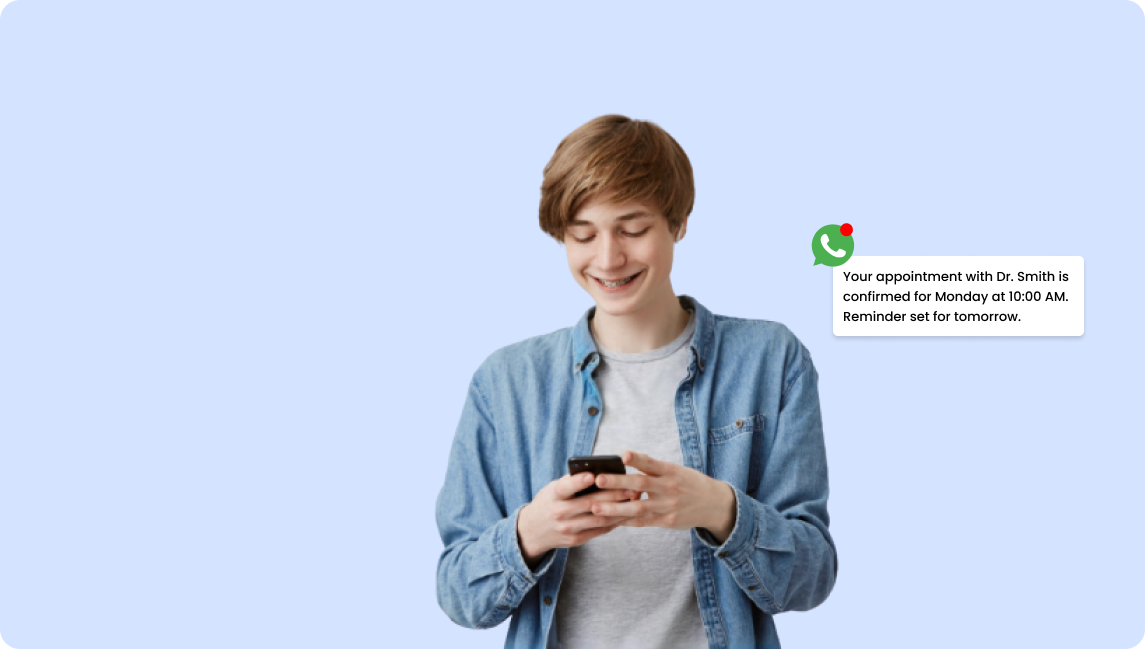
Later, John receives a confirmation message on WhatsApp:
Outcome: John successfully schedules the appointment in seconds using Facebook Messenger and receives timely confirmations across WhatsApp and email, creating a seamless experience without any waiting.

Scenario 2
It’s 3 AM, and Jack’s wife is experiencing labor pains. In a panic, Jack calls the hospital chain for immediate assistance.
Hi, my wife is in labor! We need to come in for delivery. Can you admit her now?
I’m sorry, sir, but we’re currently full. No new admissions are possible at this time.
What do you mean? She’s in labor!
Please try calling one of our other branches. They might have space.
Jack quickly contacts another branch of the same hospital chain:
We’re also full. Try calling the downtown branch.
By 5 AM, Jack has contacted 4-5 branches of the same hospital chain. Eventually, he finds a branch with an available bed, but the time lost caused a great deal of stress and anxiety during an already tense situation.
Outcome: Jack faces frustration and delays as he struggles to find an available hospital bed. The inefficient system creates unnecessary anxiety in an emergency situation.

At 3 AM, Jack uses his home voice assistant to contact the hospital’s AI-powered voice bot, which is integrated with the hospital’s backend system.
Hi, Jack. How can I assist you?
My wife is in labor. We need to come in for delivery right now. Can you tell me which branch has a bed available?
Checking bed availability across our hospital branches. Please hold for a moment…
The nearest available branch is our downtown location at 123 Oakwood Avenue. Would you like me to guide you there or arrange for ambulance services?
Outcome: The AI-powered maternity hospital’s voice bot quickly provides real-time bed availability information across the hospital’s branches and offers immediate ambulance service, ensuring Jack and his wife receive timely care. The system eliminates delays, reducing Jack’s stress during this critical moment.

Scenario 3
Mary, a diabetic patient, recently had her blood tests done and wants to check her results. She calls the hospital but gets transferred between multiple departments.
I’m calling to get my blood test results.
Let me transfer you to the lab department.
Can you provide your patient ID? I don’t have access to the results right now. Let me transfer you to the records department.
I’m sorry, but the results are not available here. I’ll transfer you back to the lab.
After multiple transfers and repeating her request several times, Mary finally gets frustrated and hangs up.
Outcome: Mary becomes increasingly frustrated after being transferred between departments without getting any concrete information. The inefficient system leaves her without the results she needs.

Mary uses the hospital’s mobile app and interacts with the AI-powered hospital chatbot to retrieve her lab results.
Outcome: Mary retrieves her test results in seconds without being transferred or having to repeat her request. The chatbot makes the process smooth and efficient, allowing her to access the results instantly.

Scenario 4
David, who recently had surgery, needs to schedule a follow-up appointment. He calls the hospital but struggles to get through to the right department.
I need to book a follow-up appointment after my surgery.
Let me transfer you to the surgical department.
I don’t handle scheduling. I’ll transfer you back to the main desk.
David is transferred back and forth between departments, unable to schedule his follow-up appointment in a timely manner.
Outcome: David becomes increasingly frustrated as he’s transferred between departments multiple times. The lack of communication and coordination delays his care.
David opens the hospital’s WhatsApp chatbot to manage his follow-up appointment.
Outcome: David schedules his appointment seamlessly without needing to speak with multiple departments. The AI-powered healthcare chatbot handles everything efficiently through the mobile app.

Scenario 5
Sarah’s elderly neighbor, Mr. Johnson, collapses, and she frantically calls the hospital for an ambulance.
My neighbor has collapsed. I need an ambulance!
Please hold while I connect you to dispatch.
After a stressful wait, the ambulance is finally dispatched, but the delay causes Sarah considerable anxiety.
Outcome: Sarah experiences unnecessary delays, making an already stressful situation worse.
Sarah uses the hospital’s voice chatbot to quickly request an ambulance.
Hello, Sarah. How can I assist you today?
My neighbor, Mr. Johnson, at 123 Oak Street has collapsed. I need an ambulance.
An ambulance is on its way and will arrive in 8 minutes. You’ll receive updates via WhatsApp.
Outcome: Sarah successfully books the ambulance in seconds using the voice bot, and the real-time updates via WhatsApp ensure she is constantly informed. The entire experience is streamlined and stress-free during an emergency.

AI-powered healthcare chatbots for patient support have transformed the
patient service landscape
across hospitals and clinics by offering seamless, multi-channel communication. Whether it’s
booking
appointments, retrieving lab results, or requesting emergency services, chatbots provide
instant,
accurate, and personalized assistance. With integration across WhatsApp, Instagram, Facebook
Messenger, voice bots, and more, patients experience fast and reliable service at every
touchpoint.
By adopting AI-powered healthcare patient service chatbots, hospitals and clinics can not only
improve operational efficiency but also deliver higher patient satisfaction through real-time,
24/7
support across all platforms.
Today companies are deploying these AI Agent on the following channels